

Aegina
Aegina, the largest island in the Argosaronic Gulf, attracts visitors from both Greece and abroad due to its proximity to the port of Piraeus. Aegina has played a significant role in various phases of Greek history, serving as the seat of the first government of the newly established Greek state in 1828, among other historical milestones.
Characterized by its picturesque landscapes, crystal-clear waters, renowned monasteries, significant archaeological sites, charming town, and beautiful villages, Aegina is globally recognized. The island is particularly famous for its pistachios, cultivated since 1860, with the local variety considered among the best internationally. Additionally, Aegina is renowned for its ceramics and lace.
Over time, the island has attracted notable figures from the fields of literature and the arts, many of whom have chosen to settle permanently or spend their vacations there.
Aegina remains a preferred destination, offering a unique experience due to its distinctive beauty and characteristics.
Sightseeing


SIGHTSEEING
The Temple of Aphaia Athena
The Temple of Aphaia Athena is the most significant monument on the island of Aegina. It is a Doric temple dating back to 500 BC
Holding a prominent place in ancient history, it is part of the "sacred triangle" along with the Parthenon in Athens and the Temple of Poseidon at Sounion. The impressive feature of the temple is its sculpted pediments, with a substantial portion displayed in the Glyptothek of Munich. Originally dedicated to the goddess Aphaia, it later became associated with Athena. The temple is situated atop a pine-covered hill near Agia Marina, with 24 out of the original 34 columns still standing today. Additionally, the Archaeological Museum of Aphaia presents exhibits and representations from the earlier temple, which was destroyed and replaced by the existing one.

SIGHTSEEING
The Temple of Apollo, the Colona
The Temple of Apollo, the Colona is located a short distance from the port and represents a significant archaeological monument in Aegina. The presence of the unique surviving column from the ancient temple of the 6th century BCE makes Kolona Hill an important religious center of the ancient city. The archaeological site of Kolona includes historical buildings from the Neolithic to the Mycenaean period, with the findings displayed at the Archaeological Museum of Kolona.
The archaeological site is also a location of historical interest, deriving its name from the columns of the Temple of Apollo, which were used by Venetian sailors for orientation. Finally, the settlement in the area is one of the most important settlements of the prehistoric period, adding even more historical and archaeological value to Kolona.

SIGHTSEEING
Paliochora
Paliochora, also known as Paliachora or Palia Chora, is an abandoned medieval settlement traditionally referred to as the "Mystras of Aegina." The archaeological site of Paliochora reflects the history of Aegina during the Byzantine era. Also known as the "Island of Mystras," it once managed to host 360 churches, one for each day of the year. Among them, 38 with stunning frescoes still survive to this day. From the Byzantine period until the early 19th century, it served as the central settlement of the island. Built on a hill north of the island, above the Monastery of Saint Nectarios.

SIGHTSEEING
The Monastery of Saint Nectarios
The Monastery of Saint Nectarios in Aegina is one of the most significant Orthodox pilgrimage sites, attracting thousands of worshippers throughout the year. It was constructed in the 20th century (between 1904 and 1910) on the site where a small Byzantine monastery existed previously.
Considered miraculous, Saint Nectarios or Nektarios of Pentapolis or Nektarios of Aegina (October 1, 1846 – November 9, 1920) is a contemporary saint of the Eastern Orthodox Church. It is believed that he performed miracles during his lifetime.

SIGHTSEEING
The Tower of Marcellos
The Tower of Marcellos, constructed around the 17th century, is considered part of the original fortifications of the harbor and was used as an observatory by the Venetians. In 1802, the Tower underwent renovation by Spyridon Marcellus, a revolutionary from Aegina, who gave it his name. During the Revolution of 1821, it was used to host Greek fighters and politicians. Today, it occasionally opens for art exhibitions and cultural events.

SIGHTSEEING
Metropolitan Cathedral of Aegina
The Kapodistrian buildings, starting with the Metropolitan Cathedral of Aegina, witnessed the swearing-in ceremony of the first Governor of Greece, Ioannis Kapodistrias, on January 26, 1828. The Kapodistrian podium, where the swearing-in took place, houses the Gospel used during the ceremony. It is the first Cathedral of the Modern Greek State, which also hosted the Kapodistrian Government and the first parliament of the modern Greek State.

SIGHTSEEING
The Governor's Mansion
The Governor's Mansion was renovated in 1827 to accommodate Ioannis Kapodistrias and the public services of the government of the fledgling Greek state from 1828 to 1829. The ground floor housed public services, while the first floor served as the residence of the governor at the time, featuring two main rooms (a bedroom and an office).

SIGHTSEEING
Orphanage of Aegina
Ioannis Kapodistrias built the Orphanage of Aegina which operated in 1828 as the first public building during his governance. It became the first intellectual center of modern Greece, an organized institution constructed to provide shelter, general, and vocational education to the orphans of the liberation struggle of 1821. This was one of Kapodistrias' initial concerns, and he inaugurated its operation in March 1829, shortly after settling on the island. The Orphanage housed the first technical schools for watchmaking, engraving, and bookbinding as well as the first National Conservatory with Byzantine and ecclesiastical music. Additionally, it hosted the first National Library, and the first Archaeological and Mineralogical Museum in the country. In 1880, it began a long period of functioning as a high-security prison for the next 104 years. Today, a part of it operates as a cultural space.

SIGHTSEEING
The Eunardio
The Eunardio (Central) School, also known as Eunardios School, is one of the most famous buildings in Aegina with iconic significance for the Kapodistrian era, and it stands as the first neoclassical building of the Modern Greek state.
The School was established at a time when it was deemed essential for the progress of Aegina, serving as the capital, to develop educational structures with certified instructors. Thus, in 1830, with a donation from the Swiss banker and philhellene G. Eunardos, a friend of the then governor Ioannis Kapodistrias, the Eunardio School was built according to the plans of architects S. Cleanthes and E. Schaubert.

SIGHTSEEING
Municipal Theater
The building of the Municipal Theateris located in the city center, on the same axis as the Eunardio and near the Temple of the Metropolis. It seems to have existed before the era of Kapodistrias. We do not know its original use with certainty. In 1828, it was initially repaired by the architect Theodoros Valianos and later by St. Cleanthes and E. Schaubert. It was used as a mutual teaching school and later as a preparatory school for students intending to pursue studies at the Higher Central School (Eunardio). Today, it is used for the needs of the Municipal Theater of Aegina and for cultural events.

SIGHTSEEING
The Ancient Olive Grove
The Ancient Olive Grove of Aegina is an extraordinary haven of natural beauty, where age-old olive trees stand unwavering against the passage of time. Their impressive trunks, resembling sculptures, bear witness to the incomparable grace of nature. The fact that the fashion house Hermès chose this location for a collection photo shoot in 2005 demonstrates its unique and refined character. The trees, some over 400 years old and others reaching up to 1500 years, constitute a real treasure. Today, amidst churches and ancient remnants, they showcase their rich history.

SIGHTSEEING
The Museum of Christos Kapralos
The Museum of Christos Kapralos, which served as the distinguished sculptor's personal workshop, highlights the cultural wealth of Aegina. Located in the area of "Plakakia," it provides a unique experience of cultural enrichment. Situated near the house of Nikos Kazantzakis, the museum is an annex of the National Gallery, offering visitors a breathtaking view of the sea. Guests can admire the impressive bronze statue of "Mother," expressing the poignant anticipation for her sailor son. The artworks, sculptures, and paintings create a stunning exhibition space, capturing the richness and diversity of Christos Kapralos's art.
SIGHTSEEING
The Folklore Museum
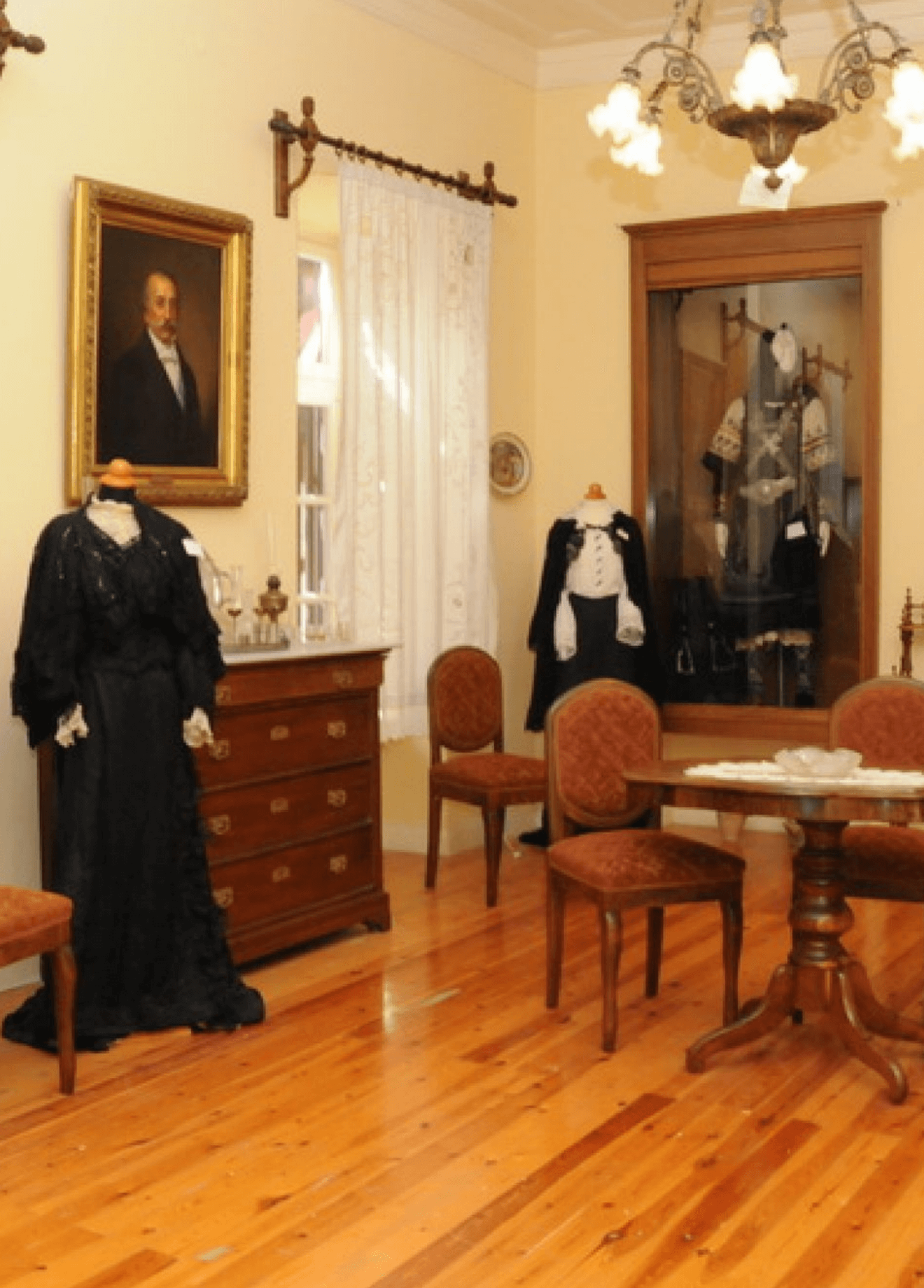
The Folklore Museum of Aegina is situated in the city center and constitutes a precious treasure of cultural heritage. Housed in a beautiful neoclassical building dating back to 1828
the first floor showcases the "Urban Aeginetan House" of the Hereotis family, presenting heirlooms, a library, correspondence, and the archive of Panagis Hereotis. It also features numerous items such as antique furniture, engravings, paintings, and traditional costumes. Additionally, the museum includes the "Village House" displaying everyday items, textiles, agricultural tools, and the "Fisherman's House" exhibiting fishing equipment, sponges, and miniature boat models.
Cultural events, such as painting exhibitions and lectures, take place on the ground floor of the building and in its courtyard.

SIGHTSEEING
The Municipal Art Gallery
The Municipal Art Gallery of Aegina, located in a single-story space (formerly the OTE building) at a privileged spot in the city, stands out as a cultural treasure in the heart of Aegina, bridging the past and present of art.
This space aspires to welcome visitors on a journey through exhibitions showcasing works by some of the most significant artists of the region and beyond. The diversity of exhibitors and the high quality of the works encourage exploration and the discovery of art in all its forms. Committed to education and cultural experience, the Municipal Art Gallery of the Municipality of Aegina highlights the rich heritage of art and provides the community with an encouraging space for creative expression and inspired dialogue.
Villages

VILLAGES
Perdika
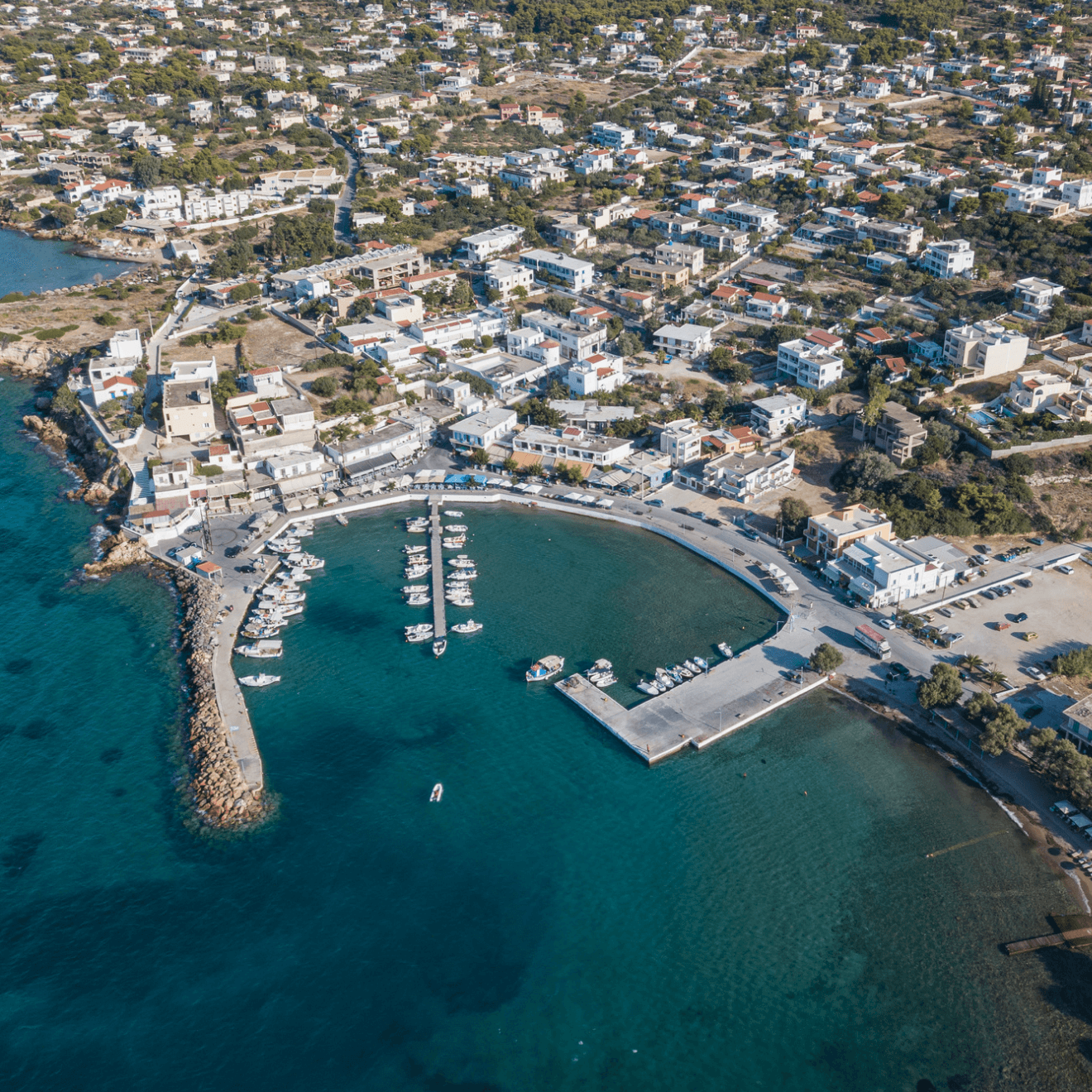
Perdika, a village that offers a unique experience, is located 9 kilometers from the port of Aegina. The narrow picturesque alleyways and white houses with their flower-filled courtyards create an ideal setting reminiscent of the beloved islands of the Cyclades. The seaside promenade above the sea, filled with ouzeri and taverns, provides the opportunity to enjoy fresh fish and seafood, while cafes and bars offer relaxed moments with a wonderful view.
The village is not only a place of hospitality but also a well-hidden secret that offers an authentic Greek experience.

VILLAGES
Agia Marina
Agia Marina is a popular tourist destination with large hotels and shops. Its beach offers the largest expanse of sandy coastline in Aegina. It is certified with the Blue Flag, meeting strict quality requirements for seawater and onshore facilities, and is considered one of the best beaches in Greece and worldwide. Along the beach, there are restaurants, cafes, and bars. On the main road, there are establishments for food, entertainment, and relaxation.
The distance from the central port of Aegina is approximately 30 minutes, and the road to Agia Marina passes through Aegio Nektarios, leading to Agia Marina. The area has its own port with direct connections from Piraeus.
VILLAGES
Sοuvαla
Sοuvαla is the second-largest port in Aegina with daily connections from Piraeus. Located 10 kilometers north of the central port of Aegina, the coastal road connecting them offers unique beauty, overlooking the azure sea and the greenery of the local vegetation.
Suvála is a picturesque fishing village with a beach, taverns, bars, cafes, hotels, and rental rooms, making it a delightful resort destination full of vibrancy and activity.
In Suvála, there is a beach with thermal waters known as "Therma," featuring a sulfur-rich thermal spring suitable for the treatment of rheumatism and skin conditions. One kilometer after Sοuvαla, to the east along the coast, you'll find the holiday village of Agioi, surrounded by lush greenery. Five kilometers away is the village of Vagia with an organized sandy beach and archaeological findings.
Beaches
BEACHES
Moni Island
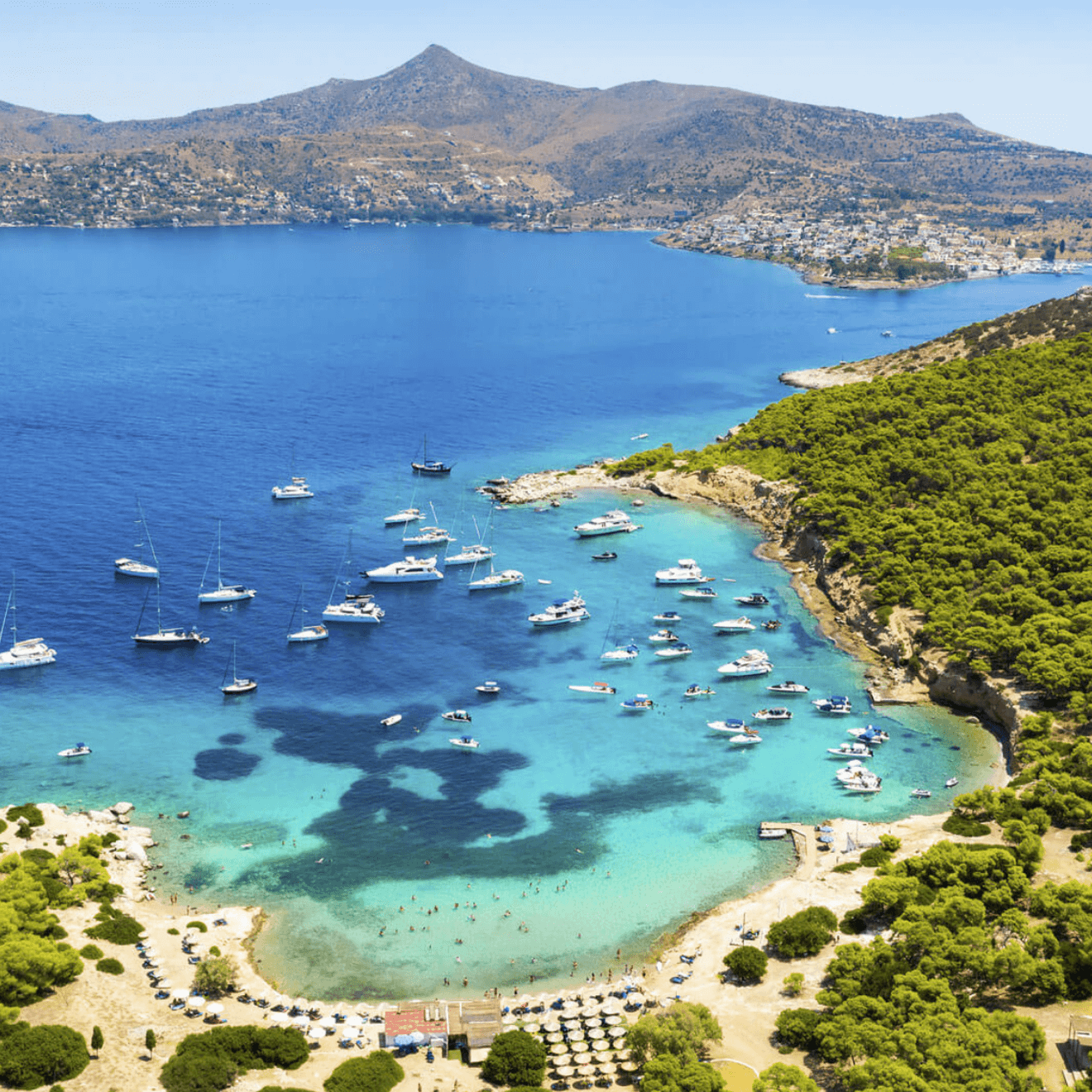
Moni Island of Aegina is located directly across from Perdika and offers a unique experience for visitors. To reach Moni, you can take the route from Perdika, first by car and then by a small boat (launch) from the harbor.
Alternatively, there is an option of a boat departing from the main port of Aegina. The travel time is approximately 10 minutes from Perdika and about 30 minutes from the center of the island.
Moni Island doesn't have permanent residents but hosts wild animals, such as deer observing you while swimming or the island's peacocks approaching you. The pine forest covering most of the island creates impressive landscapes.
Moreover, there is a sandy beach with a beach bar, while at the top of the island, you'll find the old military observatory from World War II. Visiting Moni is a unique opportunity to discover the nature and tranquility of the island and to go hiking.

BEACHES
Κολώνα & Αύρα
The beaches of Kolona and Avra are the two main beaches in the town of Aegina, offering easy access even on foot as they are located next to the island's central port.
These beaches are situated on either side of the Temple of Apollo (Kolona). The hill of Kolona creates a natural breakwater, with sandy beaches at its edges. The Aura Beach is located in front of the entrance of the archaeological site of the Temple of Apollo and is organized.
Kolona Beach is located at the back of the temple and can be approached after a short uphill walk. It is an unorganized beach but offers unique waters and sandy shores. Access to Kolona Beach is through a small stone gate.
If you have limited time on the island, these two beaches provide an excellent opportunity for a refreshing swim.

BEACHES
Μαραθώνας Α’ & Β’
The Marathonas area in Aegina offers two beautiful sandy beaches. Marathonas A' is located along the road from Aegina to Perdika, while Marathonas B' is situated approximately 500 meters further. During the summer months, both beaches are organized, providing sunbeds, umbrellas, and dining facilities.
Marathonas has become a popular accommodation destination in Aegina, being only a 5-minute drive from the city center. Alternatively, you can visit it by scooter or bicycle. Moreover, there is public transportation access, allowing easy entry to the area. The Marathonas beaches are suitable for all ages, offering pleasant moments of relaxation and enjoyment of the sunset.
BEACHES
Aeginitsa Beach
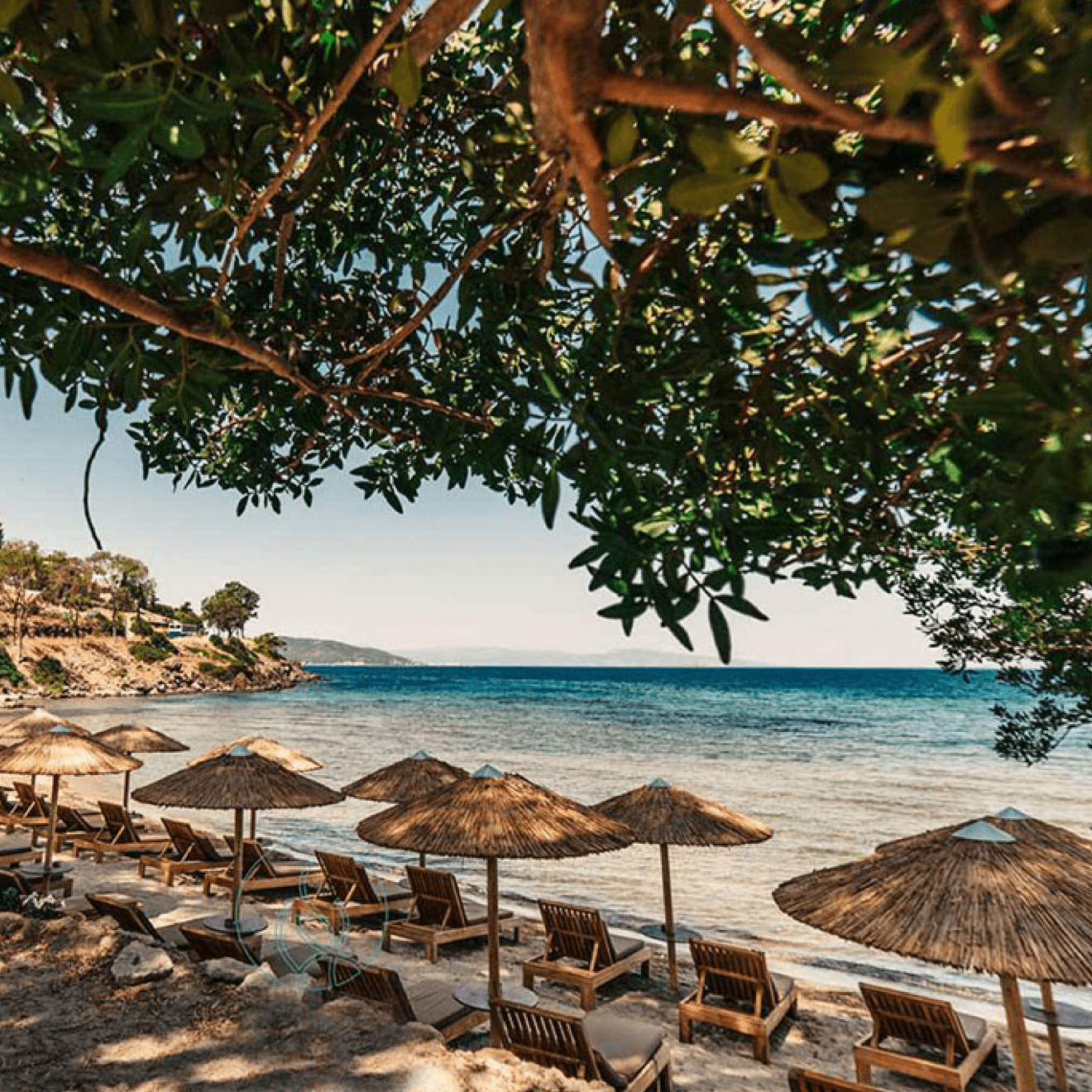
The organized Aeginitsa Beach in Aegina is located in the middle of the route from Marathonas to Perdika. It is a large cove with beautiful waters and abundant eucalyptus trees. The eucalyptus trees create shade along the beach, providing coolness and an amazing atmosphere with their fragrance.
The waters are crystal clear with turquoise blue hues. Perdika is just 2 kilometers away.

BEACHES
Klima Beach
Klima Beach is a hidden treasure for Aegina. Many consider it to be the most special beach on the island. Klima in Aegina is a small cove with crystal-clear waters. The colors of the water are attributed to the surrounding rocks, which create a beach with white sand. Typically, many boats reach this area.
The beach is organized, providing many sunbeds and umbrellas. The path to it requires attention as the uphill road is quite steep.

BEACHES
Sarpa Beach
Sarpa Beach stands out for its tranquility and crystal-clear waters. It is well-organized, providing comfort to visitors, and features a beach bar.
In recent years, Sarpa Beach has become a must-visit destination for those seeking a unique experience on the beaches of Aegina. Following the directions to Perdika and turning left upon entering the village, you will reach this idyllic beach. Transparent waters, sandy shoreline, picturesque boats, and a beautiful crowd are some of its characteristics.